Tuesday, May 11, 2010

Module 15--The Perks of Being a Wallflower


The Perks of Being A Wallflower

Synopsis: After the suicide of his best friend, cautious Charlie views life from the wall. He encounters new friends in his high school with dark secrets of their own who help him open up and face his future.

Citation: Chbosky, Stephen. The Perks of Being a Wallflower. (1999). Pocket/MTV.

My thoughts: This is a beautiful story. I'm very sad that anyone would censor it, though I suppose the content is mature in some areas. Still, this is one of my favorite novels. Chbosky does an excellent job writing a plausible story with interesting characters and excellent finale.

Library usage: Could be a good discussion book for teens. Could also be used during Banned Books Week. Could be used for GLTB themed events as well.


Review:


"Dear friend, I am writing to you because she said you listen and understand." In his letters to a never-identified person, 15-year-old Charlie's freshman high-school year (1991-92) and coming-of-age ring fresh and true. First-novelist Chbosky captures adolescent angst, confusion, and joy as Charlie reveals his innermost thoughts while trying to discover who he is and whom he is to become. Intellectually precocious, Charlie seems a tad too naive in many other ways, yet his reflections on family interactions, first date, drug experimentation, first sexual encounter, and regular participation in Rocky Horror Picture Show screenings are compelling. He vacillates between full involvement in the crazy course of his life and backing off completely. Eventually, he discovers that to be a whole person who knows how to be a real friend rather than a patsy, he must confront his past--and remember what his beloved, deceased Aunt Helen did to him. Charlie is a likable kid whose humor-laced trials and tribulations will please both adults and teens.
YA/M: Older YAs will relate to Charlie. SE.
Estes, Sally. "The Perks of Being a Wallflower." Booklist 15 Feb. 1999: 1038. Literature Resource Center. Web.


Gr. 11-up. A gay character is part of the mix in this darkly funny, explicit novel, originally published for adults. It's about a precocious but naive and cautious 15-year-old who tries to come to terms with a dreadful part of his past and discover who he is by breaking away from the "old him."
Source Citation
Zvirin, Stephanie. "The Perks of Being a Wallflower." Booklist 1 June 2001: 1863. Literature Resource Center. Web.

Module 14--Scranimals

Scranimals

Synopsis: Two children sail off to Scranimal Island, a world filled with scrambled animals like the Pandaffodil and the Porcupineapple. In rhyme, Prelutsky lifts the imagination in ways that can only be matched by Peter Sis's wonderful drawings.

Citation: Prelutsky, Jack. Scranimals. (2002). Illus by Peter Sis. New York: Greenwillow.

My thoughts: I've never really gone out for poetry, but Prelutsky is at least funny and Sis! He's amazing. I loved his mangorilla stomping through the jungle with the colorful kids in peeking on.

Library usage: It would be fun to read one or two of these then let kids design their own "scranimal." They could write a poem or draw or picture or both!

Reviews:

[(review date October 2002) In the following review, Stevenson offers a positive assessment of Scranimals, calling the book a "stunning achievement."]
Ah, landmark authors, those whose contributions are so reliably rewarding that each new book can be safely anticipated and opened with glee. And ah, the sweetness of surprise and delight when it's discovered that said author has actually managed to exceed expectation.
And so it is with Jack Prelutsky's Scranimals, in which Prelutsky takes the familiar concept of scrambled animals to dazzling new heights in this series of nineteen poems describing a visit to mythical Scranimal Island. Rejecting mundane mammalian combinations, poems here soar into the creative stratosphere with bizarre but linguistically plausible hybrids between vegetables and amphibians ("The Potatoad"), mammals and fungi ("The Hippopotamushrooms"), and birds and fish ("The Cardinalbacore"). The verse sparkles with wit and mad invention, the wordplay elegant enough to impress sophisticated readers yet precise enough to be funny to youngsters still grappling with the possibilities of poetic language; in fact, there's a Beatrix-Potteresque tendency to play elevated vocabulary for comic effect and then puncture it with the bathos of simple earthiness ("The Hippopotamushrooms / Suffer from deficient grace / And their tubby, blobby bodies / Tend to take up too much space"). There are plenty of inventive riffs on biology true and mythical (the Ostricheetahs hide their heads in the sand), and concepts are accessible enough to amuse younger audiences: they'll snicker not just at the lumbering awkwardness of the Stormy Petrelephant, an elephant with sadly insufficient wings, but at the narrators' understandable relief at its groundedness ("The Stormy Petrelephant's failures / Relieve us of absolute dread. / We love it in fields of azaleas-- / We'd hate if it soared overhead").
Yet there's more than just humor here: Prelutsky keeps the uneasy strangeness of these odd mongrels lurking in every verse, and he impeccably orchestrates sounds and cadences to suit a variety of moods. One of the finest poems, "The Detested Radishark" (see cover for a glimpse of his horrific visage), is as jubilantly sinister as Silverstein's classic "The Slithergadee." The enduring theme of rapaciousness ("For it eats what it wants, / And it always wants to eat") is made more dramatic by the vivid description ("Its appalling, bulbous body / Is astonishingly red") and the pounding and relentless pace: "And the only thought it harbors / In its small but frightful mind, / Is to catch you and to bite you / On your belly and behind." A lot of families will happily evolve a tradition of gently acting out the "catch you" and "bite you" portions, and a lot of delighted victims will happily squeal with shivery glee.
Sís' art picks up on the strange and otherworldly aspects of the poems, evincing a surreal and haunting edge to its intricately lined visions that recalls Odilon Redon (especially in the sepia-toned puffed-up Potatoad with its little potato-toad eyes). That's an additional lure for older readers, but there's enough restraint to keep things from becoming purely monstrous, especially in every picture's inclusion, in brighter, reassuring hues, of the intrepid boy and girl who are touring the island; happy tourists on their magical scooter (which has all the transportational versatility of Chitty Chitty Bang Bang), they're intrigued but unintimidated by the wonders they view. The depictions of those wonders also suggest the poetic yet thorough detailing of an old bestiary, and the mock-scientific approach (also evident in the helpful inclusion of a pronunciation guide for each animal's coined name) is enhanced by the artist's creation of an actual geography for the island (there's a table-of-contents map keyed to the poems, and endpapers sport an overhead view of the whole island). Throughout the book, the individual scenes faithfully and amusingly adhere to this geography, so readers can further entertain themselves with glimpses of neighboring habitats and their residents: a distant Petrelephant flounders amid the trees beyond the savanna wherein the Broccolions stalk the Antelopetunia, a Camelberta Peach's hump protrudes from the hills behind the Spinachicken patch. Those in the mood for more playful science can turn to the back cover, where Sís helpfully visually enumerates the biology of each Scranimal in mathematical terms: a banana + an anaconda = a Bananaconda, a panda + a daffodil = a Pandaffodil, and so on.
There's something here for just about every poetic need--for readalouds, for performances, for readalones, for reading with a flashlight at sleepovers, for taunting and amusing younger siblings. Ultimately, this is a stunning achievement--Carrollian-level poetry with art to match--that's sure to provide delight for years.


[In Scranimals, o]n Prelutsky and Sís's Scranimal Island, intrepid explorers will find such scrambled creatures as Ostricheetahs (who run very fast but also stick their heads in the sand) and Spinachickens (rather dimwitted green creatures who wilt in the heat). The verses are humorous, in the usual Prelutsky way--peppy, singsongy, and clever--as in this on the "ponderous Stormy Petrelephant ... futilely trying to fly": "Its wings are too small to support it, / They're patently only for show, / And so it is constantly thwarted ... / Up isn't a place it can go." Kids will easily get and appreciate most of the combinations (the Potatoad, the Radishark); others require a greater level of sophistication (the Camelberta Peach, the Cardinalbacore), though a helpful chart appears on the back cover. Sís's simultaneously imaginative and concrete illustrations transform a nice-enough collection of related poems into a unified whole. A picture of Scranimal Island appears on the endpapers; a map on the table of contents. Two child tourists, armed with map, binoculars, and a jauntily striped inflatable life preserver, propel themselves to the island via skateboard, using an umbrella as a sail. Though muted colors characterize Scranimal Island and its denizens, on every double-page spread Sís portrays the children and their paraphernalia in bright colors, keeping the focus on them and on the power of imagination.

Parravano, Martha V. "Review of Scranimals." Illus. Peter Sís. Horn Book Magazine 79.1 (Jan.-Feb. 2003): 91. Rpt. in Children's Literature Review. Ed. Tom Burns. Vol. 115. Detroit: Gale, 2006. Literature Resource Center. Web.
Stevenson, Deborah. "Review of Scranimals." Illus. Peter Sís. Bulletin of the Center for Children's Books 56.2 (Oct. 2002): 45-46. Rpt. in Children's Literature Review. Ed. Tom Burns. Vol. 115. Detroit: Gale, 2006. Literature Resource Center. Web.

Module 13--The Storm in the Barn

The Storm in the Barn

Synopsis: 11 year old Jack is trapped in the Dust Bowl. Faced with his sister's mysterious illness, his father's disappointment, and town bullies, Jack's life seems hopeless. But when he and his sister find a strange creature living in a barn, Jack realizes that he has the strength to return the rain to the parched Kansas land.

Citation: Phelan, Matt. The Storm in the Barn. (2009). Illus. by the author. Somerville, Mass: Candlewick.

My thoughts: This is a wonderful graphic novel. The simplistic pictures, sparse text, and weak colors all blend perfectly to make this multi-award winnig book. I would love a sequel or more by Phelan.

Libary usage: Could be used for graphic novels. Or American history. Could be a tie-in for folktales even with the Jack stories told and eluded to by Ernie.

Review:


Jack, a child of the Dust Bowl, has never seen rain--until he discovers a mysterious figure seemingly made of the stuff in an abandoned barn. Phelan's sparing use of color in his debut graphic novel is stunning; his simple yet profound storytelling and expansive, emotive illustrations masterfully evoke the complex historical and emotional landscapes charted. Review 11/09.

"The Storm in the Barn." The Horn Book Magazine Jan.-Feb. 2010: 12. Literature Resource Center. Web.
In Kansas in the year 1937, eleven-year-old Jack Clark faces his share of ordinary challenges: local bullies, his father’s failed expectations, a little sister with an eye for trouble. But he also has to deal with the effects of the Dust Bowl, including rising tensions in his small town and the spread of a shadowy illness. Certainly a case of “dust dementia” would explain who (or what) Jack has glimpsed in the Talbot’s abandoned barn — a sinister figure with a face like rain. In a land where it never rains, it’s hard to trust what you see with your own eyes — and harder still to take heart and be a hero when the time comes. With phenomenal pacing, sensitivity, and a sure command of suspense, Matt Phelan ushers us into a world where desperation is transformed by unexpected courage.Tall tale. Thriller. Gripping historical fiction. This artful, sparely told graphic novel — a tale of a boy in Dust Bowl America — will resonate with young readers today. --Candlewick
Awards:
Scott O'Dell Award for Historical Fiction
TLA Maverick List

Module 12--Manjiro


Manjiro-the Boy Who Risked His Life for Two Countries


Synopsis: Manjiro, 14, is a Japanese whaler. But when he and his companions are shipwrecked, they have no hope of returning home since Japan is closed to outsiders or those who leave its shores. Rescued by an American, Manjiro travels to the United States where he learns its customs and language. After a few years, he has the opportunity to return to his homeland where he is instrumental in opening up trade between Japan and the world.


Citation: McCully, Emily Arnold. Manjiro-The Boy Who Risked His Life for Two Countries. (2008). Illus. by the author. New York: Farrar.


My thoughts: This is a great story. The illustrations so perfectly aligned with the wondefully balanced facts and prose. I find myself rooting for Manjiro and holding my breath when he returned to Japan.


Library usage: This would be a fun tie-in with an Anime/Manga club. Or for a cultural week as an example of historical Japan.


Review:

(Primary, Intermediate) "For over two and a half centuries Japan had been closed to the outside world. Anyone who tried to return after leaving the country could be put to death." So even if Manjiro and his fellow fishermen do survive (first) a storm and (second) being lost at sea, their welcome home is uncertain. In this true story from the 1840s, Manjiro, fourteen, eventually finds himself rescued by American whalers, who take him back to New England where he diligently equips himself with the skills and acquires the funding to return to Japan almost ten years later. Though long for a picture book, the story is well told and involving; alternating half- and full-page watercolor illustrations aren't always as dramatic as they should be but provide atmosphere and historic detail. An informative note, a world map of Manjiro's travels, and a bibliography are appended.

Sutton, Roger. "Emily Arnold McCully: Manjiro: The Boy Who Risked His Life for Two Countries." The Horn Book Magazine Nov.-Dec. 2008: 723+. Literature Resource Center. Web.

Module 11--An Egg is Quiet


An Egg Is Quiet


Synopsis: The illustrations win this book. Detailed and life-size, the pictures of hundreds of eggs pair with the simple text for a fun, educational experience.


Citation: Ashton, Dianna. An Egg is Quiet. (2006). Illus. by Sylvia Long. San Francisco: Chronicle.


My thoughts: This book is so much fun. I love sitting with small ones and pouring over the illustrations and reading the facts with each. You can truly use this book with all ages to learn about how nifty eggs are.


Library usage: Could be used for an Easter program or anything on eggs. Might pair well with Sarah Weeks' Two Eggs, Please or Green Eggs and Ham.


Review:


Worthy successor to Ruth Heller's Chickens Aren't The Only Ones (1981), this engrossing album pairs images of dozens of precisely detailed eggs and their diverse wild parents to basic facts presented in neatly hand-lettered lines. Nearly all depicted actual size (and those that aren't, are consistently so labeled), Long's eggs look real enough to pick up, whether placed in natural settings or suspended on white pages. All, whether from birds, insects, reptiles, fish or amphibians, are not only identified, but Aston adds both topical phrases--"Eggs come in different sizes"--to each spread and, usually, memorably presented additional facts: "An ostrich egg can weigh as much as 8 pounds. It's so big and so round, it takes two hands to hold one egg." A delight for budding naturalists of all stripes, flecks, dots and textures. (Picture book/nonfiction. 6-9)
"Aston, Dianna: An Egg Is Quiet." Kirkus Reviews 15 Mar. 2006: 286. Literature Resource Center. Web.

Module 10--A Big Cheese for the White House

A Big Cheese for the White House

Synopsis: The town of Cheshire is known for their cheese. So when they hear that the White House will be serving their rival's product, they all contribute to make the largest cheese ever as a gift that will be talked about all over the country. They overcome the naysayers and the problems to triumph in this heartwarming true story.

Citation: Fleming, Candace. A Big Cheese for the White House: The True Tale of a Tremendous Cheddar. Illus. by Schindler, S. D. New York: DK Ink/Melanie Kroupa.

My thoughts: After reading this, I craved cheese. And more true stories. I loved this little known snippet of American history and love sharing it with new audiences. The faith of Elder John is inspiring.

Library usage: It would be so much fun to make cheese in the library based on this method. (and stinky) But perhaps a science/making butter or ice cream program instead?

Review:
Ages 4-8. It sounds like a tall tale, but it's true--well, almost. In 1801 the citizens of Cheshire, Massachusetts, made a cheese that weighed 1,235 pounds and stood four-feet high, which they delivered to President Jefferson in Washington as a New Year's Day gift. Fleming says in her historical note that the events are true but that some of the characters are not. One of her best fictional figures is the town grouser, doubting Phineas Dobbs, who is sure at every stage--whether it's collecting the milk, pressing the cheese, or transporting the gigantic offering by wagon and ship--that the task cannot be done: "I told you it couldn't be done." Schindler's lively period illustrations, in pen and watercolor with delicate cross-hatching, express the wry characterizations and triumphant larger-than-life action of the ordinary people, who take their place in the history books when they send their big cheese to Jefferson's table.

Rochman, Hazel. "A Big Cheese for the White House: The True Tale of a Tremendous Cheddar." Booklist 1 Nov. 1999: 538. Literature Resource Center. Web.

Module 9--Where's the Big Bad Wolf

Where's the Big Bad Wolf

Synopsis: In this retelling of the Three Little Pigs, Detective Doggedly appears to help solve the mystery of how the pig's houses keep getting destroyed.

Citation: Christelow, Eileen. Where's the Big Bad Wolf? (2002) Illus. by the author. New York: Clarion.

My thoughts: I loved the mystery of this, and I don't like mysteries. That is probably because the pictures were so entertaining and told the whole story. I loved particuarly the cows who were always trying to take care of the dumb little pigs.

Library usage: It would be interting to have a mystery night at the library. You could adapt this into a play of sorts and have the kids guessing what's next.


Review:

PreS-Gr. 1. Variations on the story of the "Three Little Pigs" are hardly in short supply, but this comic version has its his own pleasures, including a dumb dog detective and a wily wolf, who is literally in sheep's clothing. It's not that Detective Doggedly hasn't previously caught Big Bad Wolf, the town's only criminal. However, every time he intercepts Wolf committing a crime, Doggedly lets him go, relying on Wolf's promise that he'll never do it again. Of course, when the homes of the three little pigs keep getting blown down, the Wolf is the chief suspect. But Wolf is at home sick in bed, and the only animal at the scene of the crime is a kindly sheep who seems to be offering the pigs aid and advice ("Build a stick house. It's so easy!"). What's a detective to believe? Kids will know the answer; even little ones will be able to spot the wolf's visage under the woolly curls. As usual, Christelow provides cartoon-style artwork of the highest quality, complete with balloon dialogue. There's fun in both text and pictures, and here familiarity breeds hilarity.

Cooper, Ilene. "Christelow, Eileen. Where's the Big Bad Wolf?" Booklist 15 Oct. 2002: 410. Literature Resource Center. Web.

Module 8--Lightning Thief and Graceling

The Lightning Thief


Synopsis: After being attacked by his teacher, Percy Jackson discovers that he is the son of a Greek god, Poseidon to be exact. Taken to Camp Half Blood, he meets others like himself and begins to train to battle the evil in the world, but before he can learn much, his skills are put to the test: he has to save his mom.


Citation: Riordan, Rick. The Lightning Thief. (2005). New York: Hyperion.


My thoughts: This is the best presentation of Greek mythology I think I have ever seen. Riordan perfectly balances the new with the old myths and spins an engaging tale. The movie wasn't that great, but the book (and its sequels) is one of my top recommends.


Library usage: You could have a costume party: Have everyone come as a Greek god/goddess. Or a program on myths with this tie-in.


Review:


If you want a young person to read a book, take a lesson from Rick Riordan and start it by warning readers to close the book right away and go back to their uninformed lives. This book will bring out the readers, especially the boys, with its fast pace and adventure. Good news for Greek mythology enthusiasts: the gods are alive and well in the United States.
Perseus (Percy) Jackson is a 12-year-old half-blood doing time at Yancy Academy, a school for troubled kids. He is unaware of his true identity until the truth reveals itself in unusual ways. After losing his mother, he ends up at a summer camp for half-bloods run by Dionysus (the god of wine) and is shown to his cabin by his former Latin teacher, who turns out to be a centaur. (There is a constant thread of connection between the real and surreal, apparent in the catchy chapter titles like "A God Buys Us Cheeseburgers.") Percy carries his bad boy image into the other world and becomes a suspect in the disappearance of Zeus's lighting bolt. He has many Olympic-size obstacles to overcome before he returns to his human life. But no worries, Camp Half-Blood enrolls campers every summer. Book Two is called The Sea of Monsters. Heather Rader, Teacher, Libn., Meadows Elem. Sch., Lacey, WA
J--Recommended for junior high school students. The contents are of particular interest to young adolescents and their teachers.


Rader, Heather. "Riordan, Rick. The lightning thief." Kliatt Sept. 2006: 34+. Literature Resource Center. Web.


Graceling


Synopsis: Katsa is marked with one blue eye and one green, the sign that she has a Grace, a special ability. Some people are graced with baking or dancing, but everyone knows Katsa's Grace: the ability to kill. Forced to work as a ruthless henchman for her uncle, the king, Katsa is repulsed by her own strength. Teaming up with Prince Po, she sets out to overthrow her uncle and discovers love, redemption, and the truth of her Grace along the way.


Citation: Cashore, Kristin. Graceling. (2008). New York: Graphia.


My thoughts: I was disappointed in the ending of this one. Katsa overcomes all of her fears except her fear of commitment. I was very annoyed that she would not marry Po, but rather clung to her silly misconceptions about marriage. I liked that she would travel and work, but I think (probably because I think morality should be in every book) that they should have gotten married. Great story though. If you liked, read Saavy.


Library usage: I would like to see this used as a way to get teens to explore their own "Grace." Get the bakers to show how well they cook. Or the fashionable how to dress. Get everyone to share their talent.


Review:


In a world of gossip girls, it is perhaps refreshing to have a teenage heroine who cuts off all her hair because it gets in her way; and Kristin Cashore's eccentric and absorbing first novel, ''Graceling,'' has such a heroine. Katsa is tough, awkward, beautiful and consumed by pressing moral issues. She is extremely serious; it could be said she lacks a sense of humor.
The story is set in a rich fantasy world where children born with extreme talents, called Graces, are ''Gracelings.'' These Gracelings occupy a vexed and complicated place in their kingdoms, as they are both shunned and respected by ordinary people and exploited by kings. Katsa's Grace happens to be murder.
She can kill a man with her bare hands. This peculiar talent is discovered when, as an 8-year-old, she accidentally kills a distant cousin who is leering at women servants and touching them. Her uncle, the king, recognizes the potential of Katsa's power and begins to train her. He turns his niece into his creature, his own private girl assassin, forcing her to do the dirty work of the court: wreaking vengeance on his enemies, subduing those who dare to defy him. As one might expect, the adult world in ''Graceling'' is irrational, whimsical, cruel -- the young people band together into a secret Council, which Katsa dreams up to protect the innocent and correct the sins of narcissistic kings.
Katsa comes from the tradition of heroines like Pippi Longstocking, who scandalize the adult world with impossible feats of physical strength like lifting a horse or fighting a pirate. Katsa gets into a brawl with a mountain lion and wins. She subdues an entire army of guards. In other words, she overturns every biological reality and cultural stereotype of feminine weakness, which is a large part of her charm. She is the girl's dream of female power unloosed.
On one of her secret missions, Katsa encounters another Graceling, Prince Po, who can read minds. He also happens to be extremely handsome. After a great deal of wrangling, Katsa finally frees herself from her tyrannical uncle, and together she and Po try to save his young cousin Princess Bitterblue from her pathologically insane father, King Leck, who is in possession of a dangerous and bewildering Grace. Many harrowing adventures ensue.
There is a touching ordinariness to these characters as they go about their work breaking arms and legs. Unable to fall asleep one night, Katsa ''listened to make sure no one woke. Normal. She wasn't normal.'' As in every self-respecting fantasy story, all the good characters, the ones we're supposed to like, are freaks and outcasts. Po admits: ''I do a decent job of folding myself into normal society, when I must. But it's an act, Katsa; it's always an act. . . . When I'm in my father's city there's a part of me that's simply waiting until I can travel again. Or return to my own castle, where I'm left alone.''
In the course of her dark and eventful tale, Cashore plays with the idea of awkwardness, how at a certain age gifts and talents are burdens, how they make it impossible to feel comfortable in the world. And in this she writes a fairly realistic portrait of teenage life into the baroque courts of her outlandish kingdoms.
There is also embedded in this adventure a tempestuous love story; it begins with the two Gracelings fighting, and the anger that flows between them is as interesting as the attraction. They train together, as both are gifted in physical combat. And somehow in all of this struggle and resistance Cashore offers an acute portrayal of sexual awakening: ambivalent, rageful, exhilarating, wistful in turns.
At one point Katsa thinks of herself as a ''vicious beast that struck out at friends in uncontrollable anger.'' In many respects ''Graceling'' is a study of mysterious angers: it offers a perfect parable of adolescence, as its characters struggle with turbulent emotions they must learn to control. The consequences are more tangible than they usually are in more mundane settings -- if Katsa loses control, she breaks someone's jaw by accident -- but the principle is the same. The teenage characters in this novel, like some we may know in life, grow into their graces. They realize that their monstrous individuality is not so monstrous after all.
By KATIE ROIPHE


Roiphe, Katie. "Lady Killer." The New York Times Book Review 9 Nov. 2008: 33(L). Literature Resource Center. Web.

Module 7--No More Dead Dogs and Rules of the Road

No More Dead Dogs

Synopsis: Wallace Wallace cannot tell a lie. So when his teacher asks his opinion of the book covered in class, Wallace answers. But the teacher is unamused that his favorite book is not appreciated by all. Detention follows and hilarioty ensues as Wallace slowly takes over the theatre department, solves a mystery, wins a girl, and learns that truth . . . isn't always the most important thing.

Citation: Korman, Gordon. No More Dead Dogs. (2000). New York: Hyperion.
My thoughts: I made my coworker (who hates Old Yeller and loves theater) read this book; he loved it. The unrealistic but shockingly natural plot is perfect for middle school/high schoolers. The change of perspective keeps the reader jumping and always engaged. An excellent story.

Library usage: I think it would be entertaining to use this as a start for a censorship discussion using the premise that one man's opinion might not be another's then talk about books that the middle/high schooler's did and didn't like and why.

Review:

Gordon Korman's multigenre novel (part mystery, romance, epistolary fiction, and drama) No More Dead Dogs traces the unwonted directorial debut of its eighth-grade protagonist Wallace Wallace. After being suspended from the football team as punishment for writing a scathing review of his English teacher's favorite childhood book Old Shep, My Pal, the boy with a truth-telling fetish must learn to play politics or kiss his athletic career good-bye. Wallace serves detention for the English teacher/drama coach and is forced to endure endless rehearsal of an adaptation of the very same book for the stage. In the process, the boy discovers that he has a knack for theater and choreography, revives a lackluster performance of the canine-capping novel, and, at the same time, plays sleuth in a mystery involving a would-be saboteur of the theatrical troupe.
The joke upon which the title turns is Wallace's unhappy realization of a particular leitmotif in American literature: the sacrifice of countless dogs (e.g., Old Yeller, Sounder, Bristle Face). This becomes a metaphor for the premature loss of innocence, which the drama kids (believing they have intuited the source of Wallace's angst) chant in unison at rehearsal: "No more dead dogs." The fact is, while the book packs plot, it lacks witty follow-through of this amusing premise. We have no idea why Wallace initially champions the dog cause (other than a refusal to cater to the taste of his teacher); in fact, the book has nothing to do with the title theme whatever. Instead, No More Dead Dogs refocuses its attention on the travails of the president of the drama club, Rachel Turner, as she struggles to preserve the authority and artistic integrity of her theatrical mentor, Mr. Fogelman. Rachel, incidentally, is a girl with a bizarre fixation on Julia Roberts who writes obsessively to the star for counsel.
There are other problems with No More Dead Dogs, The book is filled with jokes aimed at an adult audience rather than one comprised of middle schoolers (e.g., one character spews a bountiful supply of mixed metaphors that the author must explain, uncommon as they are in the parlance of kids: "It's the icing on the gravy," "by any stretch of the means," "If the cake fits, eat it"). These are jokes that desperately wish to be funny but the book produces only one that would be considered genuinely amusing to its demographic. Wallace Wallace is relentlessly pursued throughout the story by a Mephistopheles-like ex--best friend named Cavanaugh who refers to the protagonist repeatedly as "Jackass Jackass." Even as I write that, I laugh--in a juvenile, David Spade sort of way. In my opinion, No More Dead Dogs had serious potential to be a much better book than the writing produced.

Graber, S. "No More Dead Dogs." Journal of Adolescent & Adult Literacy 46.2 (2002): 181. Literature Resource Center. Web.


Rules of the Road

Synopsis: Jenna works for Gladstone's Shoes where she is the best salesperson on staff. So when she's approached by the elderly president of the company, she reluctantly switches jobs from seller to driver. Together they set off on a cross-country journey from Chicago to Dallas, and what they find surprises them both.


Citation: Bauer, Joan. Rules of the Road. (1998). New York: Puffin.


My thoughts: I enjoyed this one. It was a bit predictable at places, but I really liked Jenna and particularly crumudgeony old Mrs. Gladstone. I was actually surprised to find reviews that didn't particularly like the book, though.


Reviews:

Bauer begins with an intriguing premise, weaves in unusual settings and creates an offbeat narrator to relay them. But a supporting cast of stock characters and forced dialogue may disappoint readers of her previous novels. --Publisher's Weekly

"RULES OF THE ROAD." Publishers Weekly 20 Dec. 1999: 82. Literature Resource Center. Web.


Funny young adult writers are a rare treasure, and Joan Bauer is one of the funniest. Critics and young readers rejoiced at her three previous novels--Squashed, Thwonk, and Sticks--and with Rules of the Road, she has written a story that is wise and touching as well as comical. Jenna Boller is too tall for a sophomore and she's not much good in school. Her sister Faith got all the looks in the family, but boy, can Jenna sell shoes! She's supremely happy at her after-school job at Gladstone's, where the big white sign over the door says "We're Not Just Selling Shoes, We're Selling Quality." When elderly Mrs. Madeline Gladstone, the crusty president of the company, chooses Jenna as her driver on a business trip to visit other Gladstone's stores, Jenna goes reluctantly--with trepidation at driving the huge Cadillac, and at the prospect of leaving her alcoholic father behind. But on the road, Jenna learns "great road truths" such as "Never eat at a place called Mom's, because it's a safe bet Mom's been dead for years." She also proves to be indispensable (possessing an eagle eye for shoddy quality and sloppy service), and soon learns to admire and love the irascible Mrs. Gladstone as well as her old friend, "World's Best Shoe Salesman" Harry Bender. When Harry dies suddenly, Jenna realizes that she wishes he had been her father. Trouble looms in the form of a company takeover by Mrs. Gladstone's sleazy son, Elden, "Shoe Rodent," but Jenna summons courage from Harry's memory and saves the day for quality shoes. Rules of the Road is a treat that will utterly delight readers. (Age 12 and older) --Patty Campbell Amazon.com Review
Awards: Los Angeles Times Book Prize, 1998
ALA Notable Book
ALA Best Book for Young Adults
ALA Quick Pick

Monday, May 10, 2010

Module 6--Clementine


Clementine


Synopsis: Hyper-active Clementine is a handful. Wildly creative, deeply empathetic, Clementine gets into scrape after scrape with her best friend, Margaret. In this episode, she wins the Great Pigeon War, cuts her hair . . . and Margaret's, much to Margaret's mother's consternation. You can't help but love this girl.


Citation: Pennypacker, Sarah. Clementine. (2008). Illus. Marla Frazee. New York: Hyperion.


My thoughts: I hope I have a child just like this someday. I loved Clementine, her letter, her talent show, and even the upcoming friend of the week. I think Sarah Pennypacker is a genius and deserves thousands of accolades. I got to meet her at TLA and my opinion was just further cemented because she's AMAZING! As is Clementine. This is so spectacularfully written. Engaging. Excellent illustrations. Witty story. Personable characters. Children's books at their best!


Library usage: I would love to read this aloud to kids. Sadly, it's too long to do that in a public library. But it would be fun to read parts of it aloud. It could be done as a part of an art/craft program. You could have a contest re-writing the old Clementine song using things from the book. Could have a Clementine naming contest for a library pet/mascot. Hundreds of things.


Review:

Armed with only the best intentions and a few art supplies, eight-year-old Clementine makes quite a mess out of her week. It starts on Monday when she cuts off her friend's hair and goes downhill from there. By the end of the week, she has hacked off her own hair and spent considerable time in the principal's office. With all this trouble, Clementine feels sad but not surprised when she (thinks she) overhears her parents plotting to send her away. Frazee's winning line drawings intensify the story's energy and bring to life the spirit and heart of Pennypacker's funny first-person narration. J.R.

Roach, Julie. "Clementine." The Horn Book Magazine Jan.-Feb. 2008: 26. Literature Resource Center. Web.

As Clementine says, "Spectacularful ideas are always sproinging up in my brain." All the better for readers who like to laugh. Reminiscent of both Ramona and Junie B. Jones, Clementine is an ingenuous third-grader with a talent for trouble and a good heart. Her best friend is her neighbor Margaret, a fourth-grader who experiences both qualities firsthand. After all, plenty of kids may have had their hair chopped off by a helpful friend in an effort to get the glue out, but how many of those friends would think to improve matters by drawing hair back on the scalp, forehead, and neck with a Flaming Sunset permanent marker? "It looked beautiful, like a giant tattoo of tangled worms," Clementine observes in the fresh, funny, first-person narrative. Frazee's expressive ink drawings capture every nuance of the characters' emotions, from bemusement to anger to dejection. Sometimes touching and frequently amusing, this engaging chapter book is well suited to reading alone or reading aloud to a roomful of children.

--Booklist Carolyn PhelanCopyright © American Library Association.

Module 5--Dooby Dooby Moo


Dooby Dooby Moo


Synopsis: Duck and his barnyard friends are driving Farmer Brown crazy. They're practicing for the county fair's talent show. First prize: a trampoline! Can Farmer Brown control the wild antics?

Citation: Cronin, Doreen. Dooby Dooby Moo. (2006). Illus. by Betsy Lewin. New York: Atheneum.


My thoughts: This is my favorite of the all the Duck and Farmer Brown books. I love the story and the animals singing out "Dooby, dooby, dooby moo. Dooby moo, moo, moo, moo, moo* (*that's Twinkle, Twinkle Little Star, get it??) As always the Cronin/Lewin team combine perfectly for excellent storytelling. This certainly takes first prize in my estimation.


Library usage: It would be fun to have a talent show with local kids and read this story. It could be used as an introduction to the arts. Or just good, all-around, storytime fun. Let the kids sing as animals.


Review:


The cows, duck, and Farmer Brown of Click, Clack, Moo: Cows That Type (Simon & Schuster, 2000) fame are back again in [Dooby Dooby Moo,] a hilarious, new adventure. In the newest tale, the farm animals decide to enter a talent contest at the county fair in hope of winning first prize, a trampoline. The cows decide to sing, the sheep decide to sing, the pigs decide to do an interpretive dance, and duck directs. Once again, Farmer Brown hears strange noises coming from the barn each night as the farm animals practice their act and he knows the farm animals are up to something. But what? Like the earlier titles, this is a book that children and adults will enjoy giggling over together. The lively text and energetic watercolor illustrations are highly engaging and entertaining. For a rollicking and raucous barnyard story time, pair this read-aloud with Margie Palatini's Moo Who? (HarperCollins, 2004) or Elizabeth Winthrop's Dumpy La Rue (Henry Holt & Company, 2001), which was also illustrated by Betsy Lewin.

Boyd, Kristi. "Review of Dooby Dooby Moo." Illus. Betsy Lewin. Library Media Connection 25.5 (Feb. 2007): 68. Rpt. in Children's Literature Review. Ed. Tom Burns. Vol. 136. Detroit: Gale, 2008. Literature Resource Center. Web.

Module 4--Caddie Woodlawn and The Witch of Blackbird Pond

Caddie Woodlawn

Synopsis: Retold by her granddaughter, Caddie Woodlawn recounts the tomboy activities of a young red-headed girl and her brothers as they explored the woods, got in and out of scrapes, and grew up in 1860's Wisconsin.

Citation: Brink, Carol Ryrie. Caddie Woodlawn. (1973). Illust. by Trina Schart Hyman. New York: Simon & Schuster.

My thoughts: Caddie makes me wish I were born in a different time. I've always loved the story with its humor and gentle lessons, its unexpected heroes and sweet rememberings. When I was old enough to realize that Caddie's granddaughter had written it, I was thrilled.

Library usage: It would be truly wonderful to see a grandparent/child day with scenes from this book shared as a prompt to get grandparents telling their stories to their family and youngsters. It would be a great historical tie-in too with the Civil War, Lincoln's assassination, and pioneer days such as quilting.


Reviews:

At age 11, Caddie Woodlawn is the despair of her mother and the pride of her father: a clock-fixing tomboy running wild in the woods of Wisconsin. In 1864, this is a bit much for her Boston-bred mother to bear, but Caddie and her brothers are happy with the status quo. Written in 1935 about Carol Ryrie Brink's grandmother's childhood, the adventures of Caddie and her brothers are still exciting over 60 years later. With each chapter comes another ever-more exciting adventure: a midnight gallop on her horse across a frozen river to warn her American Indian friends of the white men's plan to attack; a prairie fire approaching the school house; and a letter from England that may change the family's life forever. This Newbery Medal-winning book bursts at the seams with Caddie's irrepressible spirit. In spite of her mother's misgivings, Caddie is a perfect role model for any girl--or boy, for that matter. She's big-hearted, she's brave, and she's mechanically inclined! (Ages 9 to 12) --Amazon.com Review


Caddie Woodlawn, which has been captivating young readers since 1935, was awarded the John Newbery Medal for the most distinguished contribution to American literature for children. Now it is in a brand-new edition with lively illustrations by Trina Schart Hyman. In her new foreword, Carol Ryrie Brink lovingly recalls the real Caddie, who was her grandmother, and tells how she often "sat spellbound, listening, listening!" as Caddie told stories of her pioneer childhood. Children everywhere will love redheaded Caddie with her penchant for pranks. Scarcely out of one scrape before she is into another, she refuses to be a "lady," preferring instead to run the woods with her brothers. Whether she is crossing the lake on a raft, visiting an Indian camp, or listening to the tales of the circuit rider, Caddie's adventures provide an exciting and authentic picture of life on the Wisconsin frontier in the 1860s. And readers will discover, as Caddie learns what growing up truly means, that it is not so very different today. --Simon & Schuster

Award: Newbery Medal, 1935


The Witch of Blackbird Pond

Synopsis: Growing up in sunny Barbados, orphaned Kit Tyler is unprepared for the cold, harsh life led by her Puritan relatives. Befriended by a fellow community outcast, a Quaker woman who lives by Blackbird Pond, Kit eventually finds her place in this unknown world.


Citation: Speare, Elizabeth George. The Witch of Blackbird Pond. (1973). New York: Dell.


My thoughts: I was expecting a witch, so it was a bit disconcerting to realize that this book, so famous, doesn't have any. But I enjoyed it nonetheless. It is very well written. I really liked Kit and felt that she would be easy for me and other readers to relate to because she is faily universal: a misfit longing for acceptance.

Library usage: Would be a good tie-in for religious tolerance. Could also be used to discuss stereotypes and the Puritan/colonial way of life.

Review:

(Of Audiobook) Gr. 6-8. Hurt masterfully reads this Newbery award winner, set in seventeenth-century Puritan New England. Orphan Kit Tyler sails to the Connecticut colony to live with her aunt and uncle, but despite earnest attempts to belong, her behavior is unacceptable by Puritan standards. Criticized by the community, Kit seeks solace with a kindly old Quaker woman. Hurt's youthful voice and soft New England accent perfectly match Kit's buoyant personality and well-meaning antics. Hurt's perception of the story enables her to shift seamlessly among characters, and she ably portrays everyone, including Kit's soft-spoken aunt and her terse, unforgiving uncle. The villager's talk of heresy is thick with suspicion, and Hurt's capable reading accentuates this sense of foreboding.


Rich, Anna. "The Witch of Blackbird Pond." Booklist 1 Nov. 2002: 518. Literature Resource Center. Web.

Gr 5-8-Mary Beth Hurt gives an excellent performance in this reading of the Newbery Award-winning novel by Elizabeth George Speare (HM, 1958). The setting is the Colony of Connecticut in 1687 amid the political and religious conflicts of that day. Sixteen-year-old Kit Tyler unexpectedly arrives at her aunt and uncle's doorstep and is unprepared for the new world which awaits her. Having been raised by her grandfather in Barbados, she doesn't understand the conflict between those loyal to the king and those who defend the Connecticut Charter. Unprepared for the religious intolerance and rigidity of the Puritan community, she is constantly astounding her aunt, uncle, and cousins with her dress, behavior, and ideas. She takes comfort in her secret friendship with the widow, Hannah Tupper, who has been expelled from Massachusetts because she is a Quaker and suspected of being a witch. When a deathly sickness strikes the village, first Hannah and then Kit are accused of being witches. Through these conflicts and experiences, Kit comes to know and accept herself. She learns not to make hasty judgments about people, and that there are always two sides to every conflict. There are several minor plots as well, including three romances, which help to bring this time and place to life. Hurt's use of vocal inflection and expression make this an excellent choice for listening whether as an enrichment to the social studies curriculum or purely for pleasure.-Maureen Cash Moffet, St. Anne's Catholic School, Bristol, VA Copyright 2003 Reed Business Information. School Library Journal

Award: Newbery Medal, 1973

Module 3--Invention of Hugo Cabret and So You Want to Be President?

The Invention of Hugo Cabret
Synopsis: An orphan, Hugo Cabret lives in a Paris train station where he keeps the clock after his uncle disappears and steals to live. After an encounter with a bookish girl and a crotchety toy maker, Hugo's live begins to unwind. He had to unravel the secret of his father's life and find his future. A wonderful blend of words and pictures, Hugo Cabret truly sets the imagination on fire. The historical character of Georges Melies added in makes this a book that bursts barriers in all directions.

Citation: Selznick, Brian. The Invention of Hugo Cabret. (2007). Illus by the author. New York: Scholastic.


My thoughts: I LOVE this book. From the first time I picked it up, I was snared. The wonderful original drawings, the scenes from early motion pictures, and the moving text all combine for a dynamite package. I recommend this book more than probably any another in my library.

Library usage: I would love to use this book as a tie-in with a movie theme, particularly the history of motion pictures. I would also use it with other inventor books like Ben and Now as an exploration of the imagination and man's abilty to create.

Reviews:

Here's a dilemma for the Newbery committee ... and the Caldecott: what do you do with an illustrated novel in which neither text nor pictures can tell the story alone? Not to mention the drama to be found in the page turns themselves. A brief introduction sets the time (1931) and place (Paris) and invites readers to imagine they're at the movies. And with a turn of the page, they are, as, over a sequence of twenty-one double-page wordless spreads, a story begins. A picture of the moon gives way to an aerial shot of Paris; day breaks as the "camera" moves into a shot of a train station, where a boy makes his way to a secret passage from which, through a peephole, he watches an old man sitting at a stall selling toys. Finally, the text begins: "From his perch behind the clock, Hugo could see everything." The story that follows in breathtaking counterpoint is a lively one, involving the dogged Hugo, his tough little ally Isabelle, an automaton that can draw pictures, and a stage magician turned filmmaker, the rea-life Georges Melies, most famously the director of A Trip to the Moon (1902). There is a bounty of mystery and incident here, along with several excellent chase scenes expertly rendered in the atmospheric, dramatically crosshatched black-and-white (naturally) pencil drawings that make up at least a third of the book. (According to the final chapter, and putting a metafictional spin on things, there are 158 pictures and 26,159 words in the book.) The interplay between the illustrations (including several stills from Melies's frequently surreal films and others from the era) and text is complete genius, especially in the way Selznick moves from one to the other, depending on whether words or images are the better choice for the moment. And as in silent films, it's always just one or the other, wordless double-spread pictures or unillustrated text, both framed in the enticing black of the silent screen. While the bookmaking is spectacular, and the binding secure but generous enough to allow the pictures to flow easily across the gutter, The Invention of Hugo Cabret is foremost good storytelling, with a sincerity and verbal ease reminiscent of Andrew Clements (a frequent Selznick collaborator) and themes of secrets, dreams, and invention that play lightly but resonantly throughout. At one point, Hugo watches in awe as Isabelle blithely picks the lock on a door. "How did you learn to do that?" he asks. "Books," she answers. Exactly so.
Sutton, Roger. "The Invention of Hugo Cabret." The Horn Book Magazine Mar.-Apr. 2007: 173+. Literature Resource Center. Web.

"This groundbreaking work defies genre classification: neither text nor pictures (dramatically crosshatched pencil illustrations and movie stills) can tell the story alone, and Selznick's ability to make readers feel as if they're watching a silent movie is complete genius."


"The Invention of Hugo Cabret." The Horn Book Magazine Jan.-Feb. 2008: 11. Literature Resource Center. Web.

Awards: Caldecott Winner
National Book Award Finalist


So You Want to Be President?


Synopsis: This informational book is filled with presidential facts and follies. With stats for the number of presidents born in log cabins and presidential ages this book is sure to strike the fancy of everyone with it's wacky illustrations and interesting facts.


Citation: St. George, Judith. So You Want to Be President? (2000). Illust. by David Small. New York: Philomel.


My thoughts: I thought this book was awesome. I loved the facts and the illustrations. Everything fit together so well. The engaging book is sure to lure even the most reluctant readers into picking up the book and diving in.


Library usage: Great for President's Day or Election time. Could read aloud parts for storytime or have a scavenger hunt of fun presidential facts for kids to do.


Review:

This lighthearted, often humorous roundup of anecdotes and trivia is cast as a handbook of helpful hints to aspiring presidential candidates. St. George (Sacagawea; Crazy Horse) points out that it might boost your odds of being elected if your name is James (the moniker of six former presidents) or if your place of birth was a humble dwelling ("You probably weren't born in a log cabin. That's too had. People are crazy about log-cabin Presidents. They elected eight"). She serves up diverse, occasionally tongue-in-cheek tidbits and spices the narrative with colorful quotes from her subjects. For instance, she notes that "Warren Harding was a handsome man, but he was one of our worst Presidents" due to his corrupt administration, and backs it up with one of his own quotes, "I am not fit for this office and never should have been here." Meanwhile, Small (The Gardener) shows Harding crowned king of a "Presidential Beauty Contest"; all the other presidents applaud him (except for a grimacing Nixon). The comical, caricatured artwork emphasizes some of the presidents' best known qualities and amplifies the playful tone of the text. For an illustration of family histories, Small depicts eight diminutive siblings crawling over a patient young George Washington; for another featuring pre-presidential occupations, Harry Truman stands at the cash register of his men's shop while Andrew Johnson (a former tailor) makes alterations on movie star Ronald Reagan's suit. The many clever, quirky asides may well send readers off on a presidential fact-finding mission--and spark many a discussion of additional anecdotes. A clever and engrossing approach to the men who have led America. Ages 7-up. (Aug.)


"SO YOU WANT TO BE PRESIDENT?" Publishers Weekly 17 July 2000: 193. Literature Resource Center. Web.

Award: Caldecott Winner, 2001

Module 2--The Little Engine that Could and The Hundred Dresses

The Little Engine That Could

Synopsis: A train carrying toys to the children on the other side of the mountain breaks down. Dispairing, the toys beg passing trains to help them reach their destination, but are steadily rejected by cars too powerful and important to help. Finally, a Little Blue Engine, tiny though it is, offers to help. He "thinks he can" all the way across the mountain and into town to the delight of the toys and the boys and girls they belong to.

Citation: Piper, Watty. The Little Engine That Could. (2005) Illus. by Loren Long. New York: Philomel.

My Thoughts: This classic tale has something for everyone, and the new illustrations by Loren Long are colorful and engaging. I'm glad this popular story is still around to help kids today believe in themselves.

Library usage: I'm currently in the process of adapting this for a puppet show for our Summer Reading Club (Catch the Reading Express!). I know that the known tale combined with puppets is sure to be a hit. You could also do this story for a reader's theatre or anything with trains.

Review:

PreS-Gr. 1. The new edition of this American classic pairs the original (1930) text with artwork by Loren Long, whose previous picture books include Madonna's Mr. Peabody's Apples (2003) and Walt Whitman's When I Heard the Learn'd Astronomer (2004). Grand in scale but cozy in effect, the impressive acrylic paintings use subtle strokes of rich colors to create a series of narrative scenes large enough to be clearly visible back to the last row of storytime or classroom. The characters remain convincing as dolls, toys, and trains despite the slight changes in expression, position, and emotion that bring them to life. The most memorable elements of the artwork, though, are the fluid lines, rounded shapes, and warm colors of the lyrical landscapes, which are reminiscent of paintings by Thomas Hart Benton. Chances are the unassuming Little Blue Engine never expected such a handsome showcase, even for her finest hour, but this edition provides a brilliant new setting that many readers will prefer to the original picture book.--Carolyn Phelan

Could, The Little Engine That, and Carolyn Phelan. "Piper, Watty. The Little Engine That Could." Booklist 1 Sept. 2005: 145. Literature Resource Center. Web.

The Hundred Dresses

Synopsis: Wanda Petronski wears the same faded dress to school every day. One day, after seeing a classmate's new dress, Wanda announces that she has 100 dresses at home. The other children tease her about this since she still wears the same dress, always clean though never properly ironed. Maddie and Peggy made a game out of teasing Wanda. The truth is revealed however when Wanda submits her 100 drawings of dresses to the class's art contest. But Wanda has moved. Too late, Maddie and Peggy feel guilty for their teasing. They write a letter to apologize and with it's answer, they learn the true nature of friendship.

Citation: Estes, Eleanor. The Hundred Dresses. (1972). Illust. by Louis Slobodkin. San Diego: Voyager.

My thoughts: This is a hard book to read. The main characters are not very nice girls, and it's heartwrenching to see their abuse of Wanda. The redemption they find in the in is nice, but not quite the justice I would like in a book. I do like the artwork. The soft drawings fit so perfectly with the pace and emotion of the story. I still would like to hear the story from Wanda's side though.

Library usage: This would be fun to read over a few weeks and talk with the kids about teasing. Then you could have an art contest and have everyone draw something inspired by the book, or all draw the same thing (I wouldn't say dresses for the girls and boats for the boys, but you could).

Reviews:


Mean girls--think of Laura Ingalls's nemesis Nellie Oleson or Harriet the Spy's Marion Hawthorne--abound in children's literature. While we can shudder at their nastiness and rejoice in their comeuppance, rarely are we allowed the chance to see things from their point of view.
But Eleanor Estes's The Hundred Dresses (1944), recently reissued by Harcourt with an introduction by the author's daughter, Helena Estes, is the story of a mean girl--or, more precisely, a mean girl's best friend, all the more culpable for her self-perception. Peggy and her acolyte Maddie, "the girls who started all the fun," begin taunting the hitherto ignored Wanda Petronski the morning Wanda ill-advisedly volunteers that while she may wear the same dress to school every day, she has a hundred dresses lined up in her closet at home; shoes, too: "Every pair is different. All colors. All lined up."
And like her dresses, much discussed but not seen, Wanda is herself absent from Estes's story. The book begins, "Today, Monday, Wanda Petronski was not in her seat," and although the incidences of her victimization, and the barest outline of her life, are recalled in the narration, she is present only in retrospect. Wanda never does come back to school, and in the "now" of the story we hear from her only at the end, in a letter that is both thematically convenient and deeply ambiguous. The secret of the hundred dresses has been revealed--they are glorious drawings, which Miss Mason has hung all around Room 13. Miss Mason also has read to the students a letter from Wanda's father announcing that, in the face of prejudice, the family has moved away to the big city where "no more holler Polack," and the repentant Peggy and Maddie write a friendly note to Wanda to tell her that she won Room 13's drawing contest. Wanda doesn't reply to this letter, but she does write to Miss Mason, asking her to give the pictures away to the girls in the class, with two in particular earmarked for Peggy and Maddie. A hundred dresses, or a hundred knives?
While Peggy, her conscience easily massaged, twice assures Maddie that "[Wanda] must have really liked us," Maddie is not so sure. She tries to agree with Peggy. In an almost sardonic piece of characterization, Estes shows Maddie imagining herself heroically "saving" Wanda over and over. She even resolves to never "stand by and do nothing again." But in the end, Maddie is only able to blink back tears. Helena Estes believes the character of Maddie was based on Eleanor herself, but if so the author took no pains to withhold judgment on this little girl. While Maddie is the conscience of the book, it's a guilty one: "True, she had not enjoyed listening to Peggy ask Wanda how many dresses she had in her closet, but she had said nothing. She had stood by silently, and that was just as bad as what Peggy had done. Worse. She was a coward."
Worse. I can't imagine that as fastidious a writer as Eleanor Estes did not know precisely what she was doing in driving that single-word sentence straight to the heart of Maddie's unflinching self-analysis.
In her 1944 Horn Book review of The Hundred Dresses, Alice Jordan seems to miss this point completely. After praising the story for its "rare intuition," she writes, "Wanda is a Polish child possessing imagination and a gifted hand, in the midst of a modern matter-of-fact group of American school girls, who didn't see how she could possibly have a hundred dresses." Perhaps when it comes to schoolyard bullies Jordan is more generous--or euphemistic--than I; but still, is The Hundred Dresses truly a story about imagination versus pragmatism? I don't think it's Wanda's story at all, however much more comfortable it would be for readers to identify with her--the talented, the put-upon--than with the goodhearted but morally reticent Maddie. In 1944, it may have been possible to see The Hundred Dresses as a lesson about "being nice," and it would have been salutary, brave, even, to see it as a book about prejudice. When Jordan wrote that there was "a happy ending to a story which threatens to be sad," it's as if she couldn't bear to see the sadness in front of her, and, like Peggy, rewrote the story to make herself feel better. But now, as then, Estes's portrait of an uneased conscience is hard to look at--and just as necessary.
Roger Sutton is editor in chief of The Horn Book Magazine.

Sutton, Roger. "The Hundred Dresses." The Horn Book Magazine Nov.-Dec. 2004: 737+. Literature Resource Center. Web.

" . . . beautiful in its understanding of child character and belief in the essential goodness of a child's heart, most beautiful in blending pictures and story." --NY Herald Tribune Book Review

" . . . will take its place with the books that endure." --Saturday Review

Awards: Newbery Honor Winner, 1945

Module 1--The Runaway Bunny


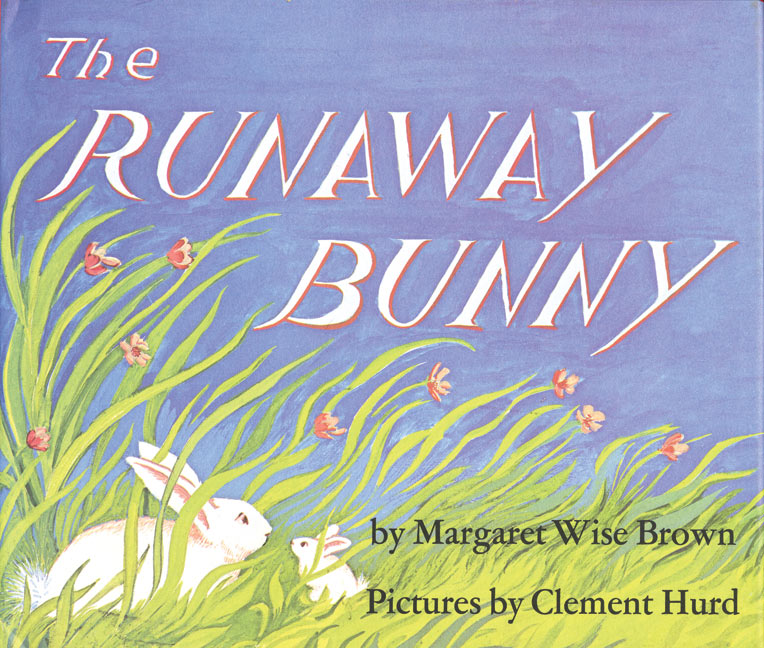
Synopsis: This endearing children's classic by the immortal Margaret Wise Brown has charmed parents for years. In the story a little bunny tells his mother that he will run away from her, but the clever mother bunny always thwarts his attempts to escape her with her love.


Citation: Brown, Margaret Wise. The Runaway Bunny. (1942). Illustrated by Clement Hurd. New York: HarperCollins.


My thoughts: I love this book, not because I can recall it was ever read to me as a child, but because of the movie Wit starring Emma Thompson. The Runaway Bunny is read during that movie as an allegory of God's love, and when put in that context, I think the true beauty of the tale shines. As far as reading it to a child, I think it is always important to tell your children that you love them and will be there for them.


Library use: I enjoy reading this book in our Lapsit program which is for parents and infants 1-2 years of age. The parents love the message, the kids love the pictures, and it teaches a lot of good vocabulary. The parody (The Runaway Mummy) is also fun to read to older groups that get the humor of the parody and love monsters.


Review:
"There is a rich background to this up-to-date, affectionate picture-book. The student of folksong recognizes a baby's variant of the old chansons in which a persistent suitor follows the elusive beloved through successive changes of form—reminding one of less affectionate duels of magicians in the Arabian Nights. That duel now becomes a duet between mother and baby. They are rabbits, but a human baby at once identifies himself with the bunny, who said to his mother, “I am running away,” to which she replied: “If you run away, I will run after you, for you are my little bunny.”
His first change is into a fish, mother becoming a fisherman: those pictures are fairly realistic, for the two-page spread shows one in the brook and the other in boots and line. When he is a bird and his mother the tree, the figures call for just a little more effort of comprehension, so that when one reaches Bunny as a boat, with a vast gray cloud-rabbit pushing his sails from the sky, even a little child has been prepared to get the idea at a glance. In the end the babys says, “Shucks, I might as well stay where I am and be your little bunny”; the mother says, “Have a carrot,” and the pictures close on a purely domestic note.
Pictures and text are in complete collaboration. Brilliant in color, the large scenes show the dreams, while realistic black-and-whites show that [The Runaway Bunny] is really a mother-play."


Becker, May Lamberton. "Review of The Runaway Bunny." New York Herald Tribune Books (15 Mar. 1942): 6. Rpt. in Children's Literature Review. Ed. Deborah J. Morad. Vol. 49. Detroit: Gale Research, 1999. Literature Resource Center. Web.