Synopsis: This endearing children's classic by the immortal Margaret Wise Brown has charmed parents for years. In the story a little bunny tells his mother that he will run away from her, but the clever mother bunny always thwarts his attempts to escape her with her love.
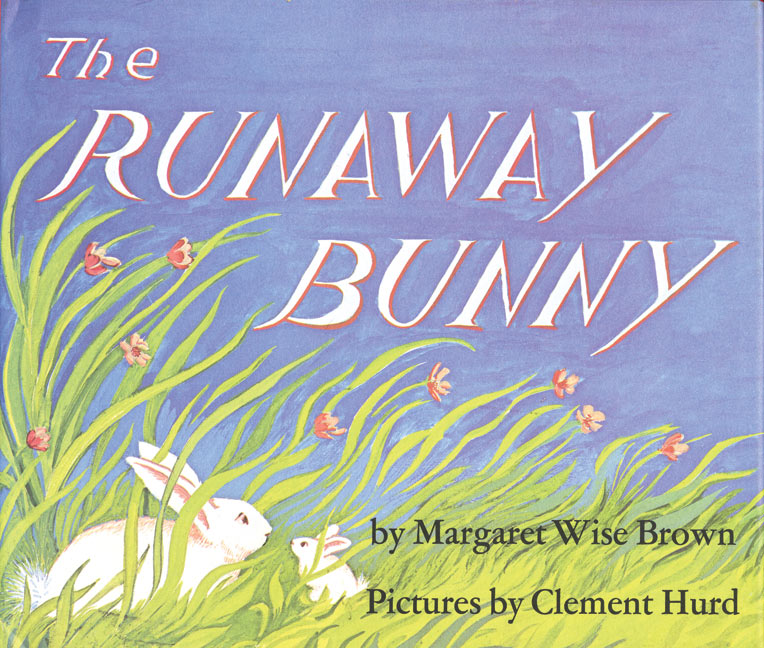
Citation: Brown, Margaret Wise. The Runaway Bunny. (1942). Illustrated by Clement Hurd. New York: HarperCollins.
My thoughts: I love this book, not because I can recall it was ever read to me as a child, but because of the movie Wit starring Emma Thompson. The Runaway Bunny is read during that movie as an allegory of God's love, and when put in that context, I think the true beauty of the tale shines. As far as reading it to a child, I think it is always important to tell your children that you love them and will be there for them.
Library use: I enjoy reading this book in our Lapsit program which is for parents and infants 1-2 years of age. The parents love the message, the kids love the pictures, and it teaches a lot of good vocabulary. The parody (The Runaway Mummy) is also fun to read to older groups that get the humor of the parody and love monsters.
Review:
"There is a rich background to this up-to-date, affectionate picture-book. The student of folksong recognizes a baby's variant of the old chansons in which a persistent suitor follows the elusive beloved through successive changes of form—reminding one of less affectionate duels of magicians in the Arabian Nights. That duel now becomes a duet between mother and baby. They are rabbits, but a human baby at once identifies himself with the bunny, who said to his mother, “I am running away,” to which she replied: “If you run away, I will run after you, for you are my little bunny.”
His first change is into a fish, mother becoming a fisherman: those pictures are fairly realistic, for the two-page spread shows one in the brook and the other in boots and line. When he is a bird and his mother the tree, the figures call for just a little more effort of comprehension, so that when one reaches Bunny as a boat, with a vast gray cloud-rabbit pushing his sails from the sky, even a little child has been prepared to get the idea at a glance. In the end the babys says, “Shucks, I might as well stay where I am and be your little bunny”; the mother says, “Have a carrot,” and the pictures close on a purely domestic note.
Pictures and text are in complete collaboration. Brilliant in color, the large scenes show the dreams, while realistic black-and-whites show that [The Runaway Bunny] is really a mother-play."
His first change is into a fish, mother becoming a fisherman: those pictures are fairly realistic, for the two-page spread shows one in the brook and the other in boots and line. When he is a bird and his mother the tree, the figures call for just a little more effort of comprehension, so that when one reaches Bunny as a boat, with a vast gray cloud-rabbit pushing his sails from the sky, even a little child has been prepared to get the idea at a glance. In the end the babys says, “Shucks, I might as well stay where I am and be your little bunny”; the mother says, “Have a carrot,” and the pictures close on a purely domestic note.
Pictures and text are in complete collaboration. Brilliant in color, the large scenes show the dreams, while realistic black-and-whites show that [The Runaway Bunny] is really a mother-play."
Becker, May Lamberton. "Review of The Runaway Bunny." New York Herald Tribune Books (15 Mar. 1942): 6. Rpt. in Children's Literature Review. Ed. Deborah J. Morad. Vol. 49. Detroit: Gale Research, 1999. Literature Resource Center. Web.

No comments:
Post a Comment